“I'd like a full refund”
A refund is money paid back, and a full refund returns the whole amount. It is often used when asking for all your money back, for example when a product is broken.
A2-30 / CEFR A2 / EPISODE 30
Asking for a refund on a broken item
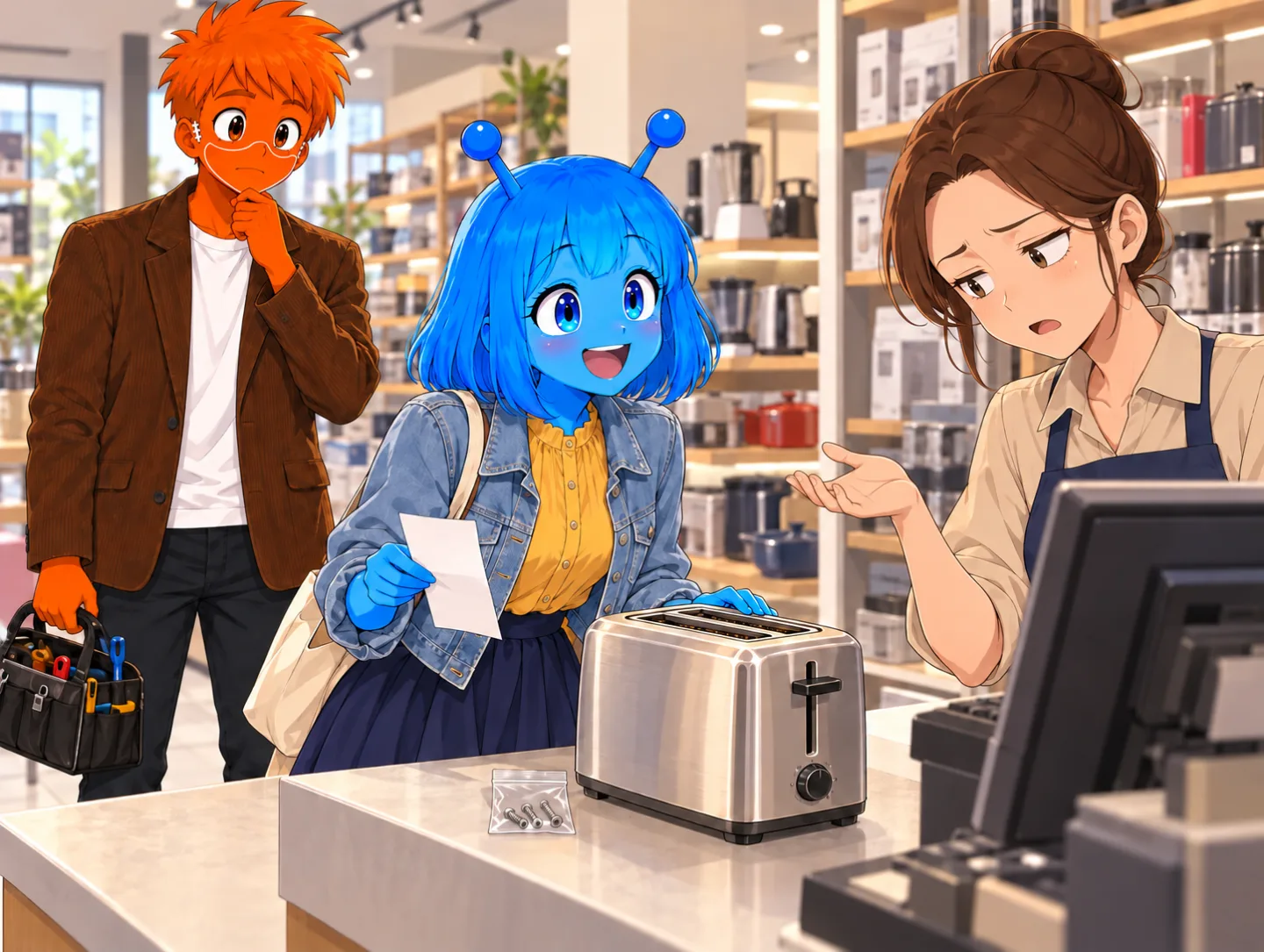
SceneAt a shop. Tina brings a clerk the broken toaster she bought yesterday, along with some leftover screws.
WORDS & CONTEXT
A refund is money paid back, and a full refund returns the whole amount. It is often used when asking for all your money back, for example when a product is broken.
Take something apart means to disassemble it; took is the past tense of take. Here back in one piece means put back together into a single whole. The clerk is asking whether the toaster was reassembled after being taken apart.
Left over means remaining, not used. Three of the screws that were removed could not be put back, so Tina has brought them in a bag along with the toaster. The humor comes from her answer "Mostly!" next to the leftover screws right in front of the clerk.
A diagram is a drawing that shows how something is built; here, the plan needed to reassemble the toaster. Where the screws go means where the screws belong, and won't guess means he refuses to decide by guessing. What Frank lacked was not a tool but a diagram. With one, he could put it back exactly; without it, he cannot be sure where the last three screws belong, and he will not just put them anywhere. The punchline is that his carefulness is what brought the reassembly to a halt.